
 886-4-25283698
 886-4-25271298
 No.21, Lane 397, Beiyang Rd., Fongyuan Dist., Taichung City 420, Taiwan
 www.tdcover.com
2026-02-10
Why Rising Polish Manufacturing Is Driving New Demand for Telescopic Covers in Heavy Machine Tools?
Introduction
In recent years, Poland has rapidly transformed from a cost-efficient Central and Eastern European production base into a strategic hub that combines EU market access, nearshoring, and regionalized logistics. As more supply chains move closer to European end markets, factories are no longer competing only on whether they can produce — they are competing on machine uptime, utilization rate, delivery stability, and long-term operating reliability.
For machine tools used across Polish heavy industry, the focus has shifted toward long continuous operation under harsh conditions: heavy cutting, extended duty cycles, high coolant usage, and chip-intensive environments. This shift is driving new demand for more robust CNC protection systems — especially telescopic covers (also commonly referred to regionally as way covers).
In large machines, protection is no longer a secondary accessory. It is a structural reliability factor. Among all protection components, the telescopic cover increasingly determines machine stability, noise behavior, leakage risk, and maintenance cost.
Protection Challenges in Large Bed Type Lathes
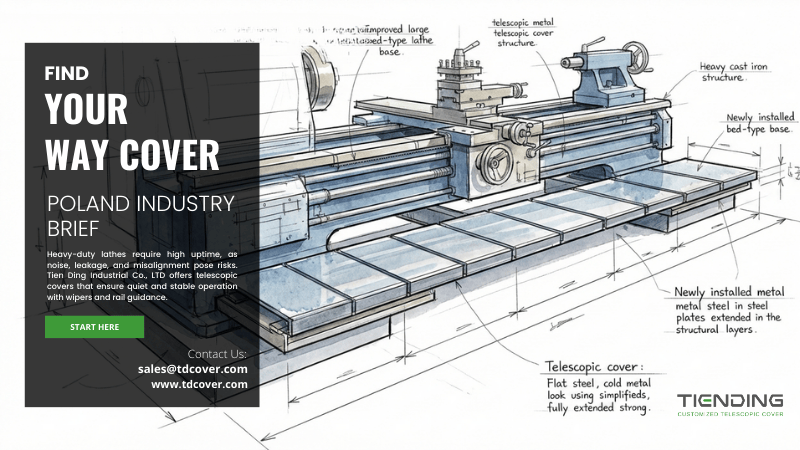
In large bed type lathe applications — widely used across Polish heavy manufacturing sectors such as energy, rail, and large mechanical components — telescopic covers must withstand multiple simultaneous stresses:
- Long reciprocating strokes
- Heavy coolant circulation
- Continuous chip impact and accumulation
- Micro angular deviation across long bed spans
Under these conditions, field failures tend to concentrate around several recurring issues:
- Increased impact noise during movement — often indicating guide wear or gap growth
- Coolant leakage — caused by poor end-face scraping or joint sealing
- Angular misalignment — leading to scratching, binding, or uneven motion
- Cover separation — usually the result of cumulative misalignment, chip jamming, wear, and insufficient guiding
In other words, telescopic covers for large lathes cannot be treated as simple add-ons. They must maintain structural control and predictable motion behavior over long-term heavy operation.
What Tien Ding Changes: From “Fits the Machine” to “Survives the Duty Cycle”
In large bed type lathe systems, telescopic cover failures rarely happen because plates are “not thick enough.” Most failures occur because long-stroke repeated motion amplifies structural weakness, guiding instability, and contact wear.
Tien Ding Industrial Co., Ltd. approaches telescopic cover engineering with four priorities:
- Impact reduction
- Motion stability
- Leakage control
- Long service life
The goal is not just installation compatibility — but long-term operational endurance.
1. Reducing Impact Noise and Improving Reciprocating Stability
Impact noise in large lathe telescopic covers usually results from segment inertia and uncontrolled motion paths. It often correlates with increasing gaps, misalignment, and accelerated wear.
Tien Ding designs motion paths to remain controlled and guided throughout the stroke range. By reducing instantaneous impact forces between segments, covers remain smooth and stable even under high-speed reciprocating motion. Lower noise levels typically indicate lower wear risk — a critical advantage for Polish factories focused on higher uptime and improved machine utilization.
2. Long Panel Length: Rigidity Engineering Beats Simply Increasing Thickness
As cover segment length increases, bending rigidity becomes the key factor affecting motion smoothness. Traditional solutions often rely on thicker plates, but this introduces new problems:
- Higher self-weight
- Increased drive and motor load
- Higher long-term energy consumption
- Accelerated mechanical wear
Tien Ding instead applies lightweight rigidity engineering through reinforced bending structures, optimized cross-section geometry, and load path redistribution. This approach significantly increases stiffness without excessive thickness. The result is lower moving mass, reduced power demand, and more stable high-speed long-stroke operation — especially valuable for large bed type lathes.
3. Contact Mechanics Matter: Line Contact Outperforms Point Contact
In telescopic cover systems, rollers and guide elements are sometimes treated as secondary components. In reality, under long-stroke heavy-load conditions, they are often the true life-limiting factors.
Tien Ding applies a clear engineering principle: Prefer line contact structures and avoid point contact ball bearing layouts where possible. The roller system is combined with self-lubricating bearings and polished round bar guides.
Compared with point contact systems, line contact distributes stress, reduces localized wear, and improves durability under long travel and heavy load. The goal is not minimum short-term friction — but predictable long-term reliability.
4. Managing Coolant Leakage in Large Lathe Environments
Large bed type lathes typically use high coolant volumes and long return paths. When coolant penetrates through joints or end faces, it can lead to contamination, corrosion, and downstream failures.
Tien Ding strengthens scraper and wiping structures at cover ends and joints to improve chip and coolant removal efficiency. This reduces internal intrusion, external leakage, and secondary water damage — improving overall system reliability.
5. Misalignment Is Inevitable — Guidance Control Is the Solution
Across long machine beds, small angular deviations are unavoidable. Without guided structural control, telescopic covers may gradually drift off path, leading to scratching, binding, or even separation.
Tien Ding integrates guided rail support concepts into telescopic cover structures to keep motion paths controlled even under long travel and contaminated environments. This greatly reduces derailment and separation risk in large machines.
Conclusion: In Poland’s Manufacturing Expansion, Telescopic Covers Can’t Be Treated as Accessories
As Poland’s heavy manufacturing and logistics sectors continue to expand, factories are no longer competing only on whether they can produce — they are competing on machine uptime, utilization rate, delivery stability, and long-term operating reliability. For large bed type lathes used across Polish industry, telescopic covers are not just protective parts — they directly influence uptime, noise behavior, leakage risk, maintenance cost, and long-term stability.
Tien Ding focuses on solving noise, stability, leakage, misalignment, and separation risks through engineering — not just materials.
If you are designing or upgrading large CNC lathe platforms for heavy-duty applications, this is the right time to review your telescopic cover strategy and contact our engineering team to discuss a more durable and application-optimized protection solution.


